Guiding processes for implementing your case study
Design Phase
Step 1 – Prepare the case study research design by specifying research objectives, cases and research questions
- Set the boundaries and the scope of your “policy focus” (e.g. policies, instruments, planning and implementation mechanisms).
- Design your case study process by:
- Identifying existing processes and key documents related to the policy focus
- Identifying key stakeholders associated to the “policy focus” (i.e. who have an influence on the implementation of the targeted policies, instruments, planning and implementation mechanisms and who can be influenced when the implementation of such elements take place).
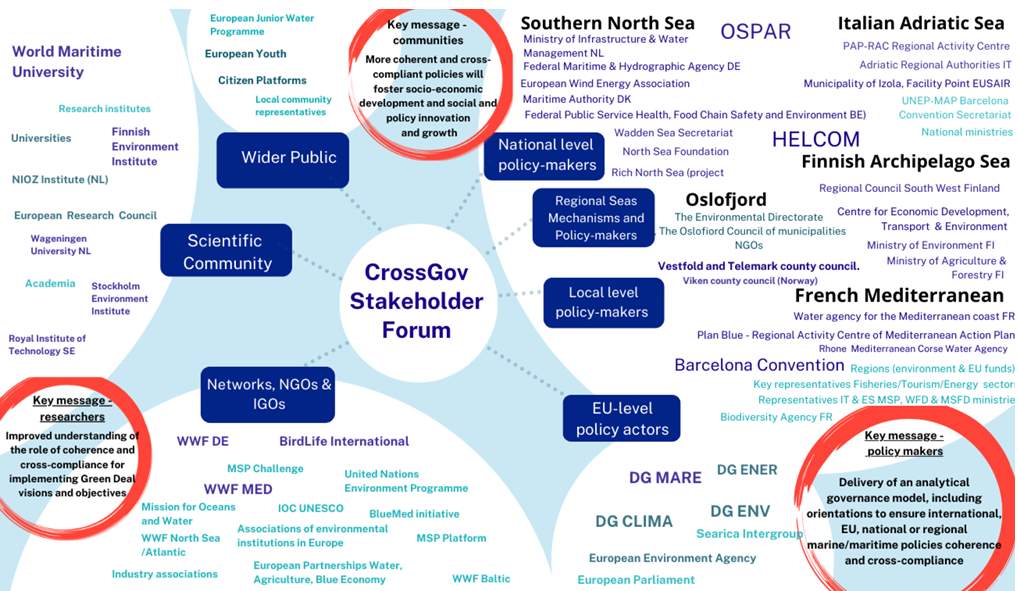
- Identifying the sources of data. Case study methodology relies on multiple sources of evidence, and although not all approaches (questionnaires, interviews, focus groups, observation processes, document analysis) can be applicable in all cases, relying on one source of data will not be enough to develop an in-depth understanding of the case.
- Prepare for your assessment: Identify gaps from the “policy focus” that are needed to be covered in order to operationalize the methodological guidelines for assessing coherence and cross-compliance and the SPS assessment.
- Risks: identify main areas of risk to complete the case study and solutions for addressing them.
Examples of risks from the Northern Adriatic Case study
- The tight time frame (10 months), which is particularly relevant when dealing with stakeholder engagement aspects (e.g. lack of time, need to contact the same stakeholders more than once, etc.)
- Stakeholder fatigue
- Challenge in transferring some of the key CrossGov concept (including coherence and cross-compliance) to stakeholders in an easy and understandable way
- Risks related with still on-going planning processes, which might change the overall context and some of the contents of key planning documents (i.e. the MSP plan of the Adriatic Sea).
Tools & Tips for the design phase
- Co-designing case study and research questions
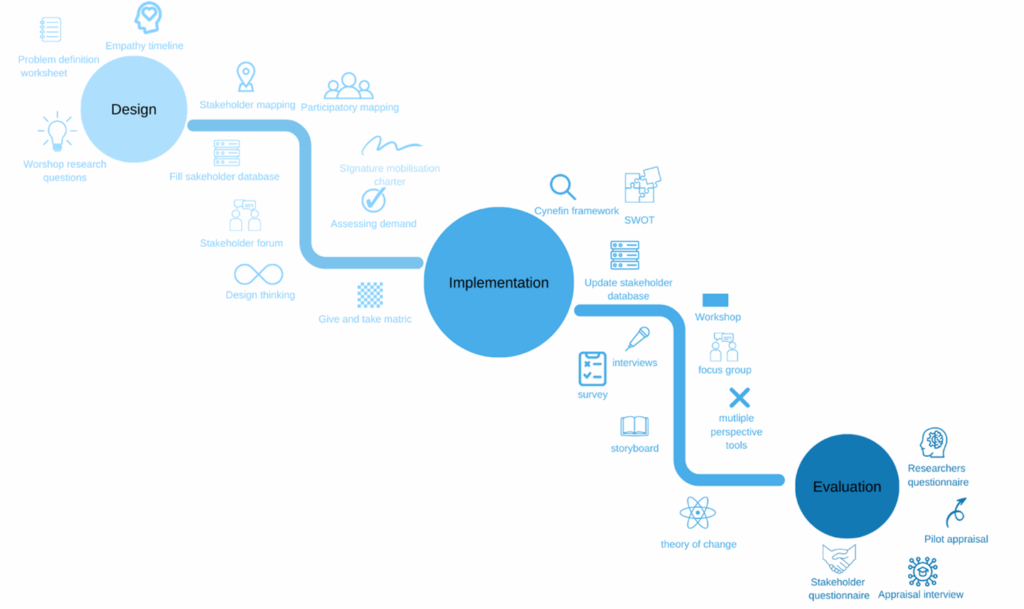
“Problem definition” worksheet helps to capture, compare and discuss different viewpoints on a vision of cross-compliance and coherence of marine planning and policies.
Method on empathy timeline that involves asking community members to think about the complexities of the issue at hand. Community members can become aware of their own subjective viewpoints on environmental problems, as this approach allows participants to think about their own personal perceptions.
Give-and-take matrix method helps to identify and facilitate potential links between case studies which allows to make a project with subprojects within an overarching framework more integrative and can lead to improved interactions.
Mapping stakeholders
- A NetMapping can be drawn to help researchers to determine which actors are involved in a given network, how they are linked, how influential they are, and what their goals are. It is a hands-on social networking tool.
- Participatory mapping: a map-making process that aims at identifying how different groups of stakeholders perceive the relationship between places and people in a specific context and over time.
Co-creation with stakeholders
- Surveys and questionnaires.
Before starting a survey or a questionnaire, the right questions must be clearly defined. Some steps must be respected when writing a survey: clarify the aim, choose the type (close-ended questions or open qualitative answers), define if there will be one unique questionnaire or many to assess an evolution. Process be aided by individual storyboards.
Semi-structured interviews are a way to facilitate interaction with stakeholders when they do not consider themselves as having enough experience to get engage in processes, such as roundtable and formal meetings.
Start with simple descriptive questions, then move to more complex structural and contrast questions
Ask open questions and do not lead the answer.
Questions in the surveys/questionnaires and interviews must be coherent.
There should be common questions to all case studies asked to stakeholders, as well as specific questions adapted to each case study.
- Co-creation workshops and focus groups: There are many existing guides, such as The MSP Guide, where you can find inspiration for techniques/tools, such as SWOT analyses or Cynefin framework, and help to turn the issue one wants to discuss into key themes and identify solutions.
Evaluation of co-creation process and ensuring uptake
- Pilot appraisal can help to sense-check the collaborative efforts of both participants and organisers. It can be a formal or informal session, but the objective is the same: to find out what went well and what could be improved. The idea is to have feedbacks on the activities, for example by organizing a vote or a sorting based on each stakeholders feeling.
- Appraisal interviews can be organized if in-depth feedbacks about the experience and marine policy performance are needed to assess the research process.
Implementation Phase
Step 2 – Implement the case studies by assessing the current marine policy state and challenges for coherence and cross-compliance
- Assess the current state of play and main areas of “success/incoherence”/lack of cross-compliance within national and sub-national policy levels – Collect data through literature, policies including laws and regulations, and interviews. Analyse data and produce key diagrams.
- Assess the expected implications and delivery mechanisms (economic, environmental, social, governance) to find interlinkages with coherence and cross-compliance.
- Share data with stakeholders for validation and input. Consolidate data by comparing with policies and legislation documentation.
- Carefully check if all the research questions have been approached during the research process
Step 3 – Draw conclusions from the cases, including on areas for improvement
Draw conclusions from the cases, including on areas for improvement: analysis of the collected data in terms of coherence, identification of mechanisms that could explain these, and conclusions on barriers and enables to ensure cross-compliant policy outcomes.
- Identify areas for improvement based on the data collected on planning and policy processes through document reviews and stakeholder interviews.
- Assess expected impacts of applying these improvements.
- Share and consolidate comparing with policies and legislation documentation with a specific focus on the condition for success in implementation regarding coherence and cross-compliance
Evaluation Phase
Evaluate the overall case study process
How to improve and upscale your research method, by assessing the added value for researchers and stakeholders of the case study.