2. How to shed light on policy coherence
About Lesson

The Framework

The evaluation framework enables the understanding of where in the policy cycle or at which governance level challenges of coherence and cross-compliance emerge, why the results are achieved and how better performance towards the EGD can be obtained.

Part A

What are we assessing?

Coherence Attributes

When assessing the level of coherence between policies, we are considering coherence between the objectives and the measures of the policies.

Policy Objective
Definition
The results and outcomes the policy sets out to achieve, as specified in the articles or text of the policy document.May be referred to in policy documents as goals, objectives, targets, commitments, or in other ways. They can be overarching, general, not quantified goals and/or specific quantified targets.
General Objectives
Are the overall goals of a policy, expressed in terms of ‘policy outcome’ or ‘policy impact’. These objectives are often broad, not quantifiable and without a specific timeline.
Specific Objectives
Are targets to be achieved to meet the general objectives. They are expressed in terms of the direct and short-term results of a policy, and tend to be measurable, have a specified time limit and may have associated indicators to measure results.
Some examples of policy objectives
Biodiversity Strategy to 2030
All the world’s ecosystems are restored, resilient and protected
General objective
Climate Law
Reduce net GHG emissions by at least 55% compared to 1990 levels by 2030
Specific objective
Common Fisheries Policy
Ensure long-term sustainable fisheries and aquaculture, the availability of food supplies and a fair standard of living for fisheries and aquaculture communities.
General objective
Zero Pollution Action Plan
Reduce by 50% plastic litter at sea and by 30% microplastics released into the environment
Specific objective
Marine Strategy Framework Directive
Achieve good environmental status in the marine environment as well as sustainable use and coherence with other EU law
General objective
Policy Measures
Definition
Specific actions that are put in place by the policy to deliver its objectives
Impacts
Besides the intended outcomes, the measures may have unforeseen impacts and may affect other policies and objectives than the ones they are meant to support. This impact on other policies and objectives may be positive or negative, foreseen or unintended.
Multiple measures
Many policies contain multiple measures. Sometimes a combination of measures is used to jointly ensure the achievement of one specific policy objective.
Some examples of policy measures
Laws and regulations can grant access to resources through licensing systems or directly prohibit certain actions.
Economic measures are intended to incentivize desired behaviors, for example through subsidies, taxes or market-based approaches such as tradable quotas.
An agricultural policy aiming to reduce run-off from fields may use a combination of regulations on the breadth of green strips along rivers, information campaigns for farmers and subsidies to compensate them for production losses.

Internal and external coherence assessments

Coherence assessments mainly concern the interrelationships between policies. However, it is useful to start the assessment with a close consideration of the individual policies that are to be compared. Understanding internal coherence of the individual policies facilitates understanding external coherence between the policies.

  • Internal coherence assessment: This step examines individual policies, their internal coherence and relation to overarching objectives (such as from the European Green Deal).

  • External coherence assessmentThis step examines the interactions within a group of policies, assessing whether they are in conflict or create synergies, and identifying where trade-offs may arise.
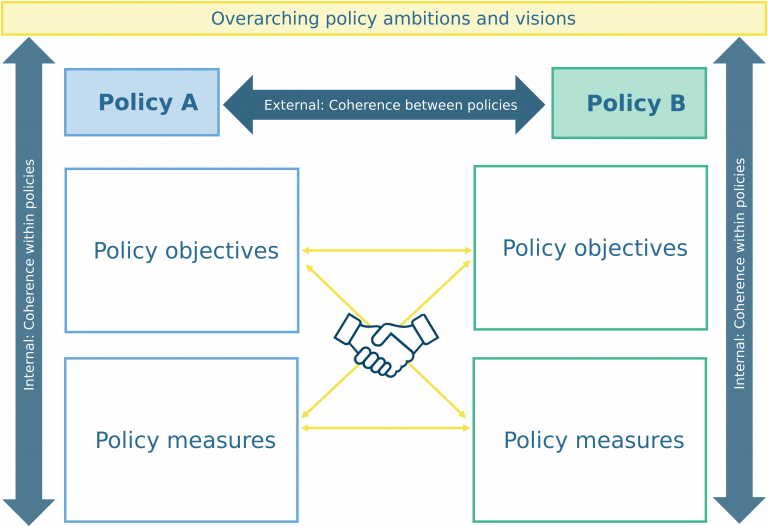
External and internal coherence assessments

Light and in-depth coherence assessments

For both internal and external coherence assessments, we provide two options:

  • Light coherence assessment: Can be conducted based on expert or stakeholder opinion and can provide a first mapping of policy coherence. It can also be done based on an analysis of policy
  • In-depth coherence assessment: Asks more detailed questions to guide the assessment. The recommended methodology includes a desk-based study (analyzing policy documents, legal acts, case law, and secondary literature) combined with expert interviews. The detailed guiding questions help answer the overarching questions from the light coherence assessment in more depth.

Part B

Explanatory variables

In addition to assessing coherence, the framework raises the question why results are achieved, providing evaluations of reasons for success or failures. 

A set of explanatory factors (categories of barriers and enablers) helps to understand the reasons behind varying levels of policy coherence.

These explanatory factors play a key role in policy design and implementation. They can help pinpoint why policies are incoherent and how coherence can be enhanced. Examples are added throughout the chapter to illustrate various barriers and enablers.

1

Governmental Organisations

Hold the primary responsibility for designing and implementing policies. These organizations range from local (such as municipalities) to national (like agencies or ministries) to EU and international levels (for example, EU Directorates, UN agencies). A policy issue is often managed by several governmental organizations. The interactions between these organizations, including coordination, distribution of responsibilities, and power dynamics, affect the design and implementation of policies. This interplay is a key factor in explaining the occurrence of coherence or incoherence.

2

Science-policy-society interfaces (SPSI)

Describe processes of how knowledge and data is being produced, transferred, and utilized in decision-making processes. Effective SPSIs can promote and support policy coherence, as they allow for evidence-based policy processes. Exploring SPSIs implies to look at the various actors involved in the knowledge system, what type of knowledge is being used, and how it influences decision-making.

3

Stakeholder involvement

Describes how different interested and affected parties participate in policymaking and policy implementation.

Inclusive and transparent involvement can generally enhance coherence by ensuring that multiple perspectives are considered. In turn, unbalanced stakeholder involvement that is strongly dominated by certain powerful actors can have the opposite effect and cause incoherence. Investigating existing stakeholder involvement mechanisms and power dynamics is therefore important for explaining different levels of coherence between policies.

The role of policy coherence for the achievement of policy impacts
0% Complete