

The North Adriatic case study has focused on evaluating how MSFD, WFD, and MSPD contribute to the European Green Deal (EGD) biodiversity targets and whether sectoral policies, such as those governing fisheries and aquaculture, adequately consider biodiversity protection goals.
The case study covers the Italian Northern Adriatic, from Friuli Venezia Giulia to Veneto and Emilia Romagna, including marine areas between the Italian coastline and the continental shelf boundary set with Slovenia and Croatia. It extends to land, incorporating major river watersheds like the Po, Adige, and Isonzo.
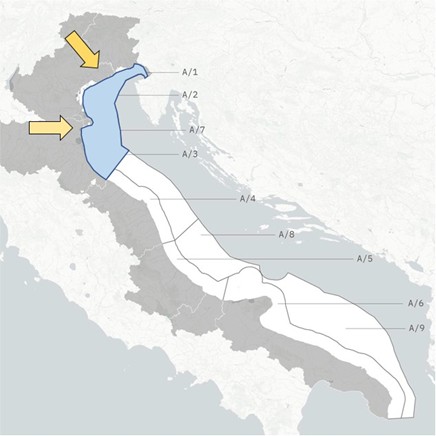
The National Management Plans for hydraulic dredges and trawling (MIPAAF, 2019; MIPAAF, 2011) indirectly contribute to biodiversity conservation. For example, dredge fishing regulations:
While the trawling plan:
Trawling is permanently prohibited within the 3 nautical miles from the coastline baseline.
In addition, MASAF annually issues a Decree (e.g. MASAF, 2024) establishing the summer ban for most of the fisheries (e.g. in 2024, from July 31 to September 13). The same decree extends the trawling ban to 6 nautical miles in the period before and after the overall summer ban (e.g., from July 1 to October 31 in 2024), except for “small trawlers” (units registered in the IV category authorized for local fishing within 6 miles and units with an overall length of up to 15 m), which are allowed to operate beyond four miles.
MASAF, in collaboration with local administrations and scientific institutions, can establish Biological Protection Zones (ZTB) where fishing is strictly regulated (e.g. trawling is in general prohibited). The study area includes several ZTBs of small/medium size: in the area between Filtri and Barcola that includes the Miramare MPA, tegnue di Chioggia, tegnue di Porto Falconera Caorle, and Fuori Ravenna. Moreover, the scientific community has advanced a proposal for the establishment of the so-called “Soles Sanctuary” Fishery Restricted Area (FRA), located astride the demarcation of the continental shelf agreed between Italy and Croatia (activity carried out in the context of the DORY Project – Interreg between Italy and Croatia; Bastardie et al., 2017).
The EMFAF National Program 2021-2027 (MASAF, 2022a) integrates fisheries and biodiversity actions by supporting
The four FLAGs (Fisheries Local Action Groups) in the region, funded by EMFAF, play a key role in supporting the improvement of the sustainable management of the sector. Their initiatives include collaboration with research institutes and NGOs on biodiversity projects (such as Caretta caretta protection; e.g., the TARTATUR Project, promotion of the use of selective fishing gear, bycatch monitoring, fisher education, and recovery programs.
FLAGs also contributed to management plans for two Natura 2000 sites (IT3270025, IT4060018) off the Po Delta, designated for the conservation of Caretta caretta and Tursiops truncatus. Conservation measures adopted by Veneto and Emilia Romagna include reducing fishing pressure on these species (e.g., banning longlines and hook lines in the two sites) and restricting other activities like windsurfing and kitesurfing to prevent species disturbance (Decision No. 710 of 17/05/2021 by Emilia Romagna; Decision No. 1135 of 06/08/2020 by Veneto Region).
Aquaculture activities have spatial and environmental interactions with other uses and economic activities of the sea and can generate negative or positive externalities directly or indirectly. According to the Technical Guide for the Allocation of Marine Areas for Aquaculture (AZA), these interactions can be classified as: incompatible, potentially compatible (e.g. with Natura 2000 sites), and compatible. The guide also recommends considering a distance to be respected (standoff distance) when allocating areas for aquaculture, this is a buffer area to reduce the negative impacts aquaculture may have on sensitive areas (e.g. MPAs).
ISPRA guidelines have been followed by Veneto Region for the elaboration of the draft AZA Plan for the maritime compartments of Chioggia and Venice (Resolution 1651/2023). As required by the Technical Guide, in the initial phase of identification of marine zones, the interaction between AZAs and protected areas was considered. Therefore, the AZAs plan, as proposed, has located the new aquaculture areas in sites where there are no expected negative interactions with MPAs or Natura 2000 sites. Moreover, in the final definition of the AZAs, other elements were evaluated and taken into consideration, such as the interference with trawling fishing activities and maritime traffic (mostly in front of the Venice Lagoon and its Malamocco inlet in particular)
Powered By EmbedPress