The Netherlands: A Multi-faceted Approach
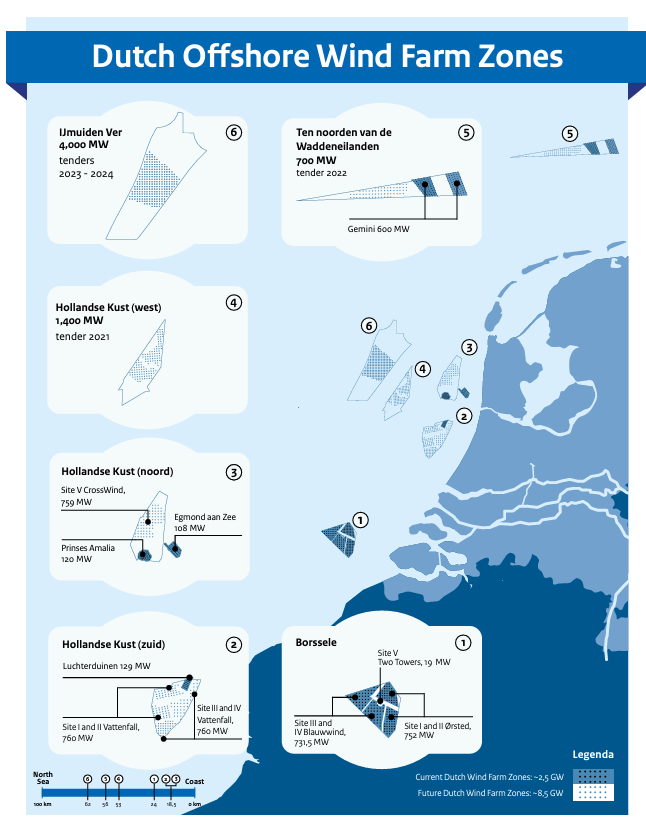
The Netherlands has established ambitious offshore wind energy generation targets: 21 GW by 2030, 50 GW by 2040, and 70 GW by 2050.
To achieve these goals, the Dutch government has designed a comprehensive and integrated strategy that strives to balance energy production with environmental protection. Its key policy tools and planning instruments are described below.
North Sea Programme 2022-2027
Strategic Environmental Assessments (SEAs), Appropriate Assessments (AA), and the Framework for Assessing Ecological and Cumulative Effects (KEC)
Nature-inclusive design and multi-use strategies
Stakeholder engagement
The Dutch regulatory framework aims to balance ecological, spatial, and industrial needs.
Environmental considerations, in the form of measures for biodiversity protection and restoration, and area-based management tools, such as Marine Protected Areas (MPAs) are explicitly integrated into spatial planning. In particular, the Dutch MSP stipulates that offshore wind parks should not be developed in Natura 2000 areas, MPAs under the Marine Strategy Framework Directive (MSFD), or crucial habitats for protected species. This policy reflects stakeholder consensus reached within the North Sea Consultation (Noordzee Overleg) and the ensuing North Sea Agreement (NSA), which outline commitments for nature-inclusive wind farm design and the implementation of best available techniques to minimize negative environmental effects and generate positive impacts, primarily in the form of nature enhancement measures.
Strengths of the Dutch Framework
- Proactive government role in site selection and pre-development.
- Integrated spatial planning and one-stop-shop permitting.
- Centralized site studies and grid connections handled by TennET lower developer risks and attract investments
- Engagement of multiple stakeholders (North Sea Agreement, NGOs, industry).
- Incentives for nature-inclusive offshore wind design, for instance, by inclusion in award criteria under tender procedures
- Innovative approach to multi-use of marine space
Challenges in Integrating Energy and Environmental Goals
- SEA limitations: Late-stage role, abstract assessments, and knowledge gaps.
- Need for better coordination between planning and permitting stages (institutional fragmentation)
- Uncertainty in long-term ecological impacts of offshore wind expansion.
- The role of the MSFD goal of GES and descriptors is still vague (not really enforceable)
- Gaps in assessing cumulative impacts
- The exemptions from environmental rules pose risks for the project-level assessment of impacts which can affect the mitigation measures, the capacity to apply an adaptive management approach, the identification of appropriate compensation measures or the calculation of appropriate compensation
- Cumulative impact assessment limitations. Multi-use introduces further challenges to an already convoluted exercise plagued with unknown unknowns.
- Lack of cross-border coordination on MSP.
Lessons for Improving Coherence in Energy and Environmental Policy
- Strengthening the role of SEA in early-stage site selection.
- Improving transboundary coordination for MSP and ecological assessments.
- Enhancing adaptive management and long-term monitoring.
- Aligning marine conservation commitments with offshore wind expansion.