From the Green Deal to the Ocean Pact
Increasing Policy Coherence to reach our most ambitious marine goals
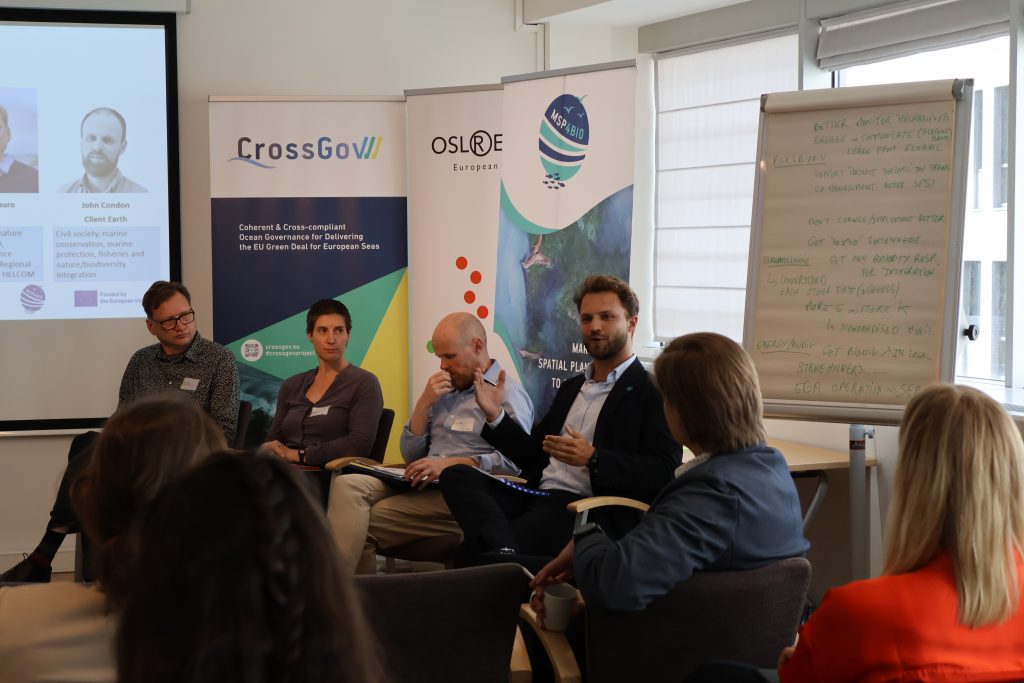
In June 2025, the Horizon-Europe CrossGov and MSP4Bio projects gathered 35 policymakers, researchers, and stakeholders for a one-day workshop dedicated to policy coherence challenges and solutions. Organised in Brussels with support from the Horizon-Europe Permagov & Blue Green Governance projects, this policy workshop highlighted key challenges faced when aligning policies and regulations, while identifying practical solutions that could pave the way to more coherent and effective ocean governance.
Solutions to address policy coherence challenges…
What is the optimal level of policy coherence and integration?
Policy coherence is not a black and white phenomenon
- Better alignment between objectives, rules and actions facilitates implementation.
- At the same time, each policy needs to give priority to its own objectives, leading to frictions and tradeoffs.
- In some cases, tensions resulting from policy incoherences can steer innovations and new approaches, leading to positive solutions in the long run within a wider EU iterative policy process. Thus, it is important to identify
how much policy coherence and integration are required.
From paper to practical implementation
Misalignments lead to policies working “against each other”, with opportunities for cross-compliance not being seized.
Both CrossGov & MSP4Bio have developed assessment frameworks to assess policy coherence, as there is no agreed (common) methodology for such assessments. The frameworks identify policy coherence challenges, bottlenecks and causing factors – as the basis for developing recommendations to deliver efficiently policy outcomes. Both frameworks cover vertical (EU <-> national <-> subnational <-> local) and horizontal (across sectors) coherences throughout the policy cycle. Specific attention is given to:
- the setting up of the policy agenda;
- the definition of policy objectives and selection of measures;
- governance structures
- science-policy-society interfaces (SPSI)
- stakeholder involvement.
Solutions to address policy coherence challenges are many depending on the policy interface investigated
Impact Assessments
Inclusive of ecosystem boundaries, transboundary effects and multiple pressures
Minimum (marine) ecological standards into permits
Standardised monitoring system
for both MSFD and MSPD
Transparency of Impact level
of stakeholders contributions into decision making outcomes
A One Ocean Knowledge System
co-managed by relevant institutions, representing different policies and sectors
And...
- Financial support for transition of “unsustainable” sectors;
- Clear responsibility for policy integration to one authority;
- Biodiversity at a higher political priority level;
- Policy literacy, to support mutual awareness of policy-makers across their different domains
- Data harmonisation
From paper solutions to real changes
For solutions to be effectively considered they need to be:
Practical and Operational
Some of the solutions discussed remain rather general and difficult to bring on board of the policy cycle
Shared to the right person(s) at the right time
Some of the solutions discussed are already put in practice by some Member States (MS), Regional Sea Conventions (RSC) or at the European Commission (EC) scale: these could receive further publicity and be shared as source of inspiration.
Opportunities ahead for strengthening (marine) policy coherence
Overall, the European Ocean Pact represents a great opportunity for addressing some of the priority policy integration challenges that limit the protection and sustainable use of the ocean.
Revision of MSFD and MSPD required under the Ocean Pact can enhance their synergies in: implementation cycles, consultation & stakeholder processes, assessments, effective application of Ecosystem-Based Approaches (EBA), cross-sectoral cooperation between different governmental bodies.
Reconsider the overall paradigm of EU policy and societal framework. Ensuring full consideration of ecological (e.g. ecological ceiling) and social (equity, justice…) foundations in the EU Blue Economy; Application of socio-ecological approaches in the sustainable use of the ocean; Regeneration over exploitation.
"How coherent is coherent enough?” remains unclear
More evidence on the practical implications, impacts and added-value of different levels of policy coherence and integration is required.
Concurrently, we need to shed light on the ocean-related political processes to ensure policy coherence within political pathways. Efficient communication on how to exploit synergies between biodiversity and sector policies is of particular importance, if we want policy integration opportunities offered by the Ocean Pact to be fully seized.