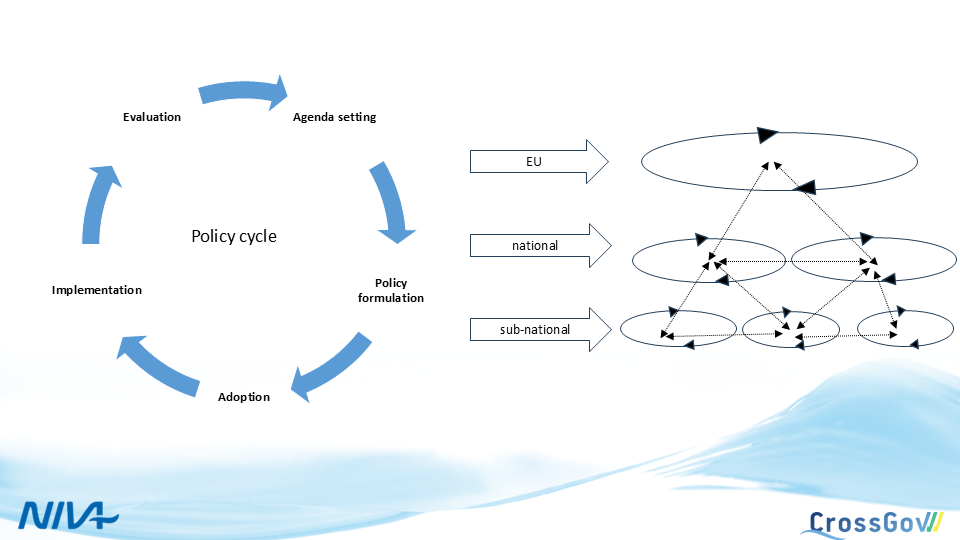
In this clip from the first CrossGov episode “Understanding the ambitions for the European oceans, regulatory realities and the need for policy coherence“, Gunnar Sander (NIVA) explores the challenges occurring from the initial stages of policy formulation to its ultimate implementation in multi-level governance systems.
From policy formulation to implementation
The recognition that complex societal issues require holistic and integrated management approaches is not novel, and over time several conceptual frameworks and terminologies related to policy coherence have emerged, such as policy integration and multilevel governance. Research in this field provides valuable insights into the necessity of coherence, methods for analysis, and the factors that influence coherence.
Policy integration
Can be regarded as the umbrella concept of inter-sectoral policymaking. It has often been described as a stepwise approach for how organizations (such as sectoral authorities) move from siloed policy formulation and implementation towards increased cooperation, coordination and finally towards integrated policymaking (Meijers & Stead, 2004). The figure below shows the characteristics associated with the steps of integrated policymaking. Policy coherence can be understood to increase along the ladder of integration as priorities and objectives become increasingly aligned. Policy integration is motivated by the pursuit of greater efficiency and effectiveness. Integrated policies are more efficient because they minimize conflicts and foster synergies across different policy areas, leading to lower costs. Likewise, integrated policies are more effective as these synergies and reduced conflicts facilitate the achievement of policy objectives without being compromised by other policies. Consequently, coherence is a fundamental attribute of integrated policymaking, linking the concept to both efficiency and effectiveness.

The implementation theory
Implementation research is a good lens through which a holistic perspective on the policy process can be observed. The theory emphasizes that for understanding the results of policies, the preceding stages of the policy cycle and the policy design also must be taken into account. Søren Winter has presented a framework for implementation studies that zooms in on the events in the implementation phase, but also takes into account the whole policy cycle (figure below). It is meant as a roadmap for investigations, presenting some key factors that affect policy results. Moreover, it is open towards specialized approaches in policy-disciplines that focus on only single stages or mechanisms.
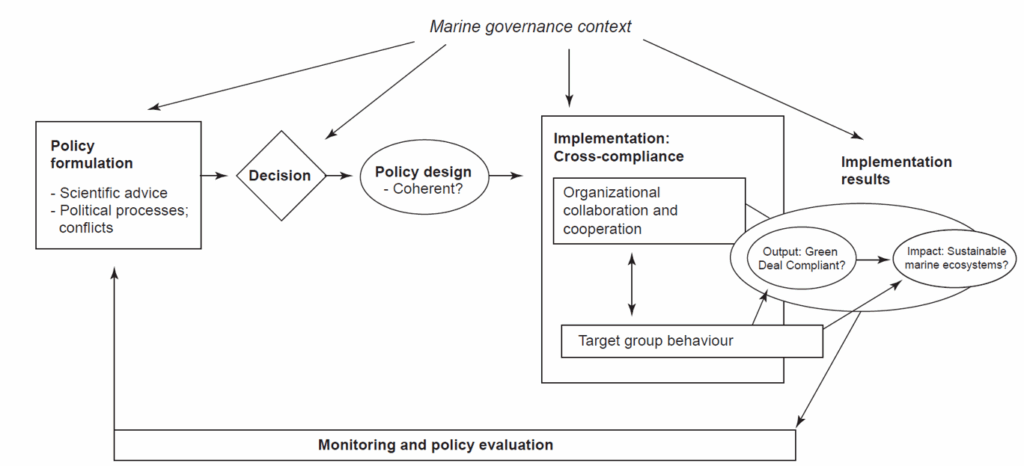
A common research question in implementation theory is ‘What has been achieved, and why?’ The achieved results can be described by two evaluation standards: output is the delivered results after implementation, for instance a regulation that has been put into practice and starts to work. Such working outputs lead to impacts, termed outcomes by Winter. This can be measured according to the problems that motivated the formulation of the policy, for instance climate change or pollution.
Multilevel governance
Multilevel governance (MLG) systems are referred to as nested or polycentric governance, emphasising that decision-making has been decentralized between a multitude of actors located at different levels.
The vertical dimension in MLG refers to the dispersion of governance across jurisdictional levels, recognizing that anchoring of policies at different levels is more effective. Horizontally, MLG captures the coordination across actors from different organisations or policy areas and takes place at all levels of governance, from national to local settings.
Policy coherence is amongst principles for good practice in MLG, and is assessed by looking at how well incentives are aligned horizontally and vertically, and to what extent the MLG system exploits synergies and reduces contradictions.

Government- and governance-centric approaches
In government-centric approaches, terms like “holistic government,” “whole-of-government,” and “joined-up government” describe efforts to reform the public sector by overcoming fragmentation across organizational boundaries. These approaches aim for more integrated, cross-sectoral strategies. This integration is primarily achieved through procedural and organizational means, such as inter-departmental and inter-administrative coordination efforts, including common plans or task forces. These efforts facilitate the exchange of information and the creation of a shared understanding of policy issues, moving along the ladder of integration (Tosun and Lang 2017). In governance-centric approaches, policy integration describes how decision-making processes move away from hierarchical structures and integrate non-governmental actors such as civil society and private sector (Meijers and Stead 2004; Tosun and Lang 2017).
How can we overcome challenges related to multilevel, multi-sector fragmented policy landscapes when we want to achieve multiple EGD ambitions?
Useful reading
This report from The BlueGreen Governance project is highly recommended to understand the major barriers and opportunities to the coherence of existing policies. It provides guidance and insights into the most prevalent (sets of)
institutional barriers and enablers for change in marine and coastal governance.
Below you can find the full scientific review from where the results of the report were extracted and synthesised. Chapter 3 investigates the (in)coherence across European marine and coastal policy landscapes, and provides a structured overview of elements that influence positively and negatively the level of policy coherence.
References
- Meijers, Evert, and Dominic Stead. 2004. “Policy Integration: What Does It Mean and How Can It Be Achieved? A Multi-Disciplinary Review.” 2004 Berlin Conference on the Human Dimensions of Global Environmental Change: Greening of Policies – Interlinkages and Policy Integration.
- Tosun, Jale and Achim Lang. 2017. Policy integration: mapping the different concepts. Policy Studies, 38(6), 553–570. https://doi.org/10.1080/01442872.2017.1339239.
- United Nations, 2021. CEPA strategy guidance note on Promotion of coherent policymaking. CEPA strategy guidance note on promotion of coherent policymaking | Public Institutions.
- Winter, Søren. 2012. “Implementation Perspectives: Status and Reconsideration.” In The Sage Handbook of Public Administration, 2nd ed., 265–78. Sage Publications.